My Garage Door Jammed the Morning the Temperature Dropped — Here's the One Thing I Wish I'd Known
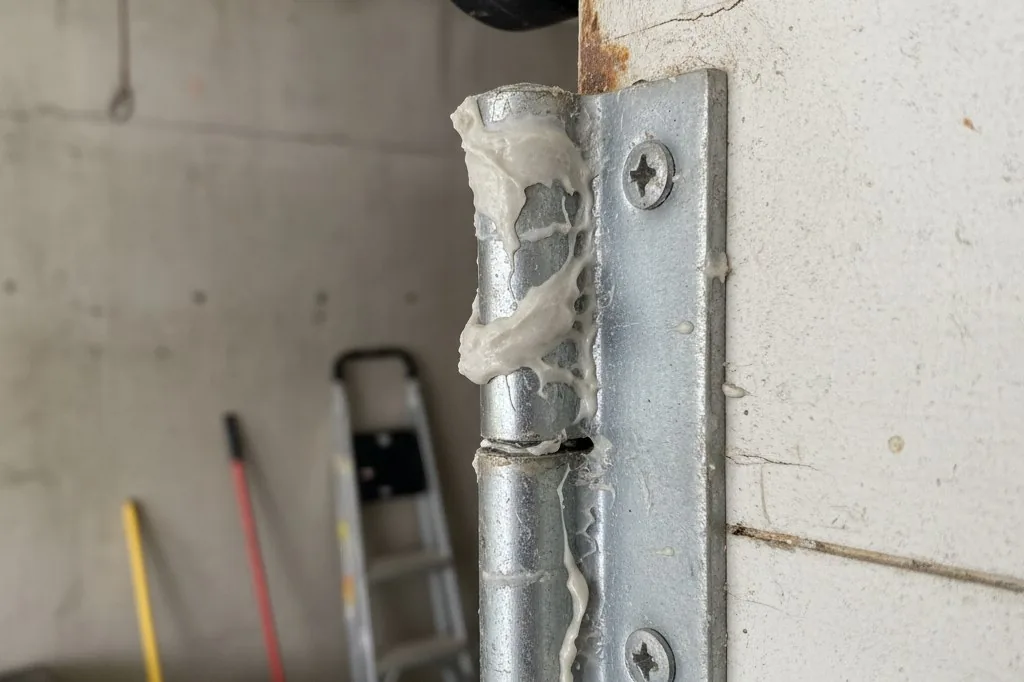
Grease Goes Hard
Here’s what I didn’t know: the lithium grease I’d used back in April can thicken dramatically when temperatures drop into the teens. Not just get a little sluggish — actually stiffen into something that resists movement.
Above a certain temperature, it stays slippery and does exactly what you want. Below that point, it turns into something closer to paste. And when that happens on a moving part that’s trying to spin or slide under a couple hundred pounds of load, friction goes up instead of down. Way up.
That night hit 19°F — right at the edge of where standard lithium grease starts to lose its flow. The can I’d used didn’t list a minimum temperature rating, because I hadn’t thought to check for one. It was labeled “garage door lubricant,” and I assumed that meant it worked in a garage, in any weather.
The worst spot turned out to be the roller stems.
Those are the metal pins that connect each roller wheel to the vertical edge of the door itself. The wheel spins around the stem as the door travels up and down the track. On my door, that’s thirteen rollers per side — twenty-six total contact points that have to rotate freely every single time I open or close the door.
The stems sit inside a bracket that’s bolted to the door, and they’re under constant load from the door’s weight. They move with every inch of travel, spinning dozens of times during a full open-close cycle. And they sit right at the edge of the door, exposed to whatever temperature the garage is sitting in, with no protection from the cold.
When the grease on those stems went stiff overnight, the rollers couldn’t turn freely anymore. The opener motor tried to pull the door up, met unexpected resistance, drew more current than it should, and the safety sensor did exactly what it’s designed to do: it killed the power before the motor burned out.
That explained the half-second hum I’d heard when I pressed the button. The motor started, hit resistance, and the automatic shutoff kicked in before anything broke.
I tested this theory by putting a space heater in the garage and letting it run for an hour. When the air temperature climbed back up into the forties, I tried the opener again. The door moved. Slowly at first, with a little groaning from the rollers, but it moved. By the time the garage hit 50°F, the door was operating normally again.
I could’ve scraped off the old grease and tried again with what I had. But there’s a better fix — one that works in serious cold and costs about the same as a drive-thru lunch.