I Ignored a Dripping Outdoor Faucet All Winter — Then Found the Pipe Split in Spring
What Freezing Water Does
You probably know water expands when it freezes. That’s eighth-grade science, and it’s absolutely true — roughly 9% more volume as ice.
What I didn’t appreciate until I started digging into this is that a pipe full of ice doesn’t necessarily split right where the ice forms. The failure happens somewhere else entirely, often inches or even feet away from the coldest spot.
When water freezes inside a pipe, it creates a solid plug. That plug traps water between itself and the closed valve downstream. As more water freezes and expands, it pressurizes the liquid water still trapped in that section.
Think of it like squeezing a toothpaste tube with both ends capped. Something has to give.
The copper doesn’t fail where it’s coldest or where the ice actually sits. It fails at the weakest point along the pressurized section — often a joint, a bend, or a thin spot in the wall. The pressure can reach thousands of pounds per square inch if the trapped water has nowhere to go and the temperature keeps dropping.
In my case, that weak point was right behind the brick, where the pipe made a 90-degree turn into the house. The cold Minnesota air hit that elbow hard, but the real killer was hydraulic pressure from ice forming closer to the valve.
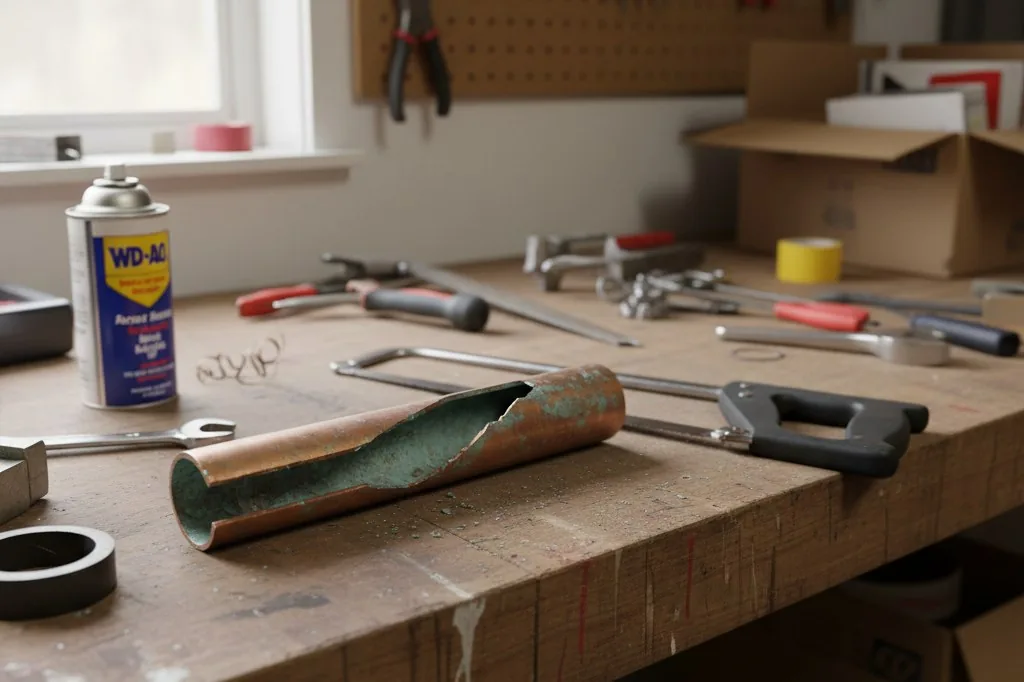
I could see it when I opened up the wall. The split was on the outside curve of the elbow, right where the copper had been stretched thinnest during the original bend. That’s where the metal was maybe thirty thousandths of an inch instead of the usual forty — just enough difference to matter when the pressure spiked.
The pipe nearest the exterior wall had a faint white frost on it even in March, but it was intact. The rupture was eight inches further in, where the wall was warmer and the pipe should have been safer.
That’s the thing about freeze damage: it’s not always where you expect it. The coldest point creates the problem, but the failure shows up wherever the pipe is already stressed — a bend, a joint, a spot where the installer’s reamer left a burr on the inside.
So why did the drip make it so much worse?