The Same Fence Panel Blew Out Three Times Before I Found the Real Problem
The Post Looked Fine
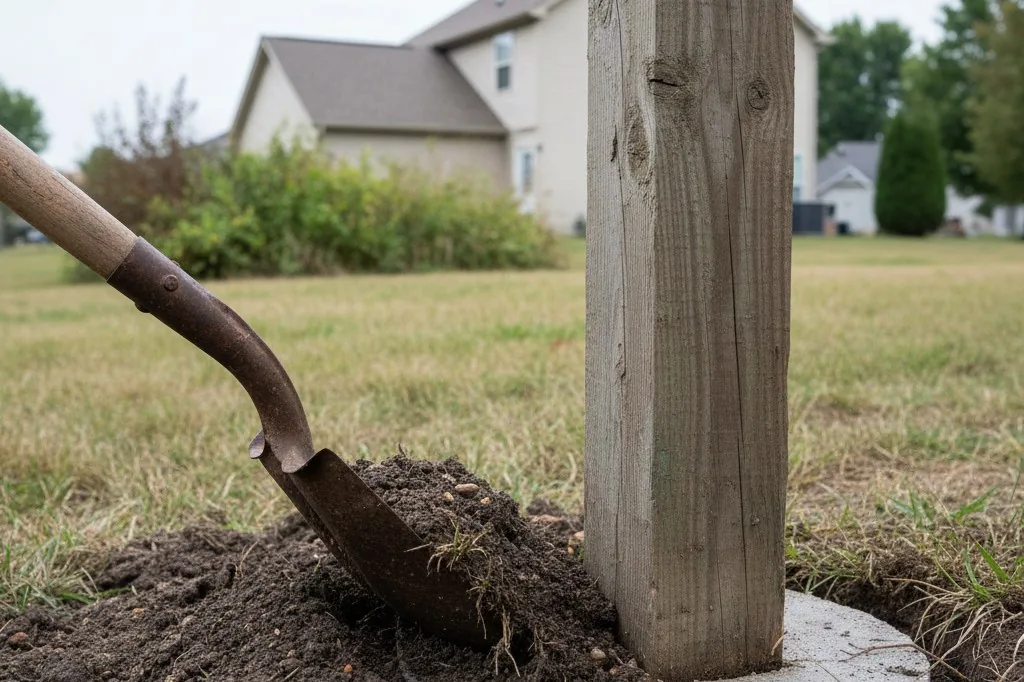
I dug down about eighteen inches, clearing the dirt away from the concrete footing on both sides of the post. I used a narrow trenching shovel so I wouldn’t disturb more ground than I needed to, and I worked carefully in case I hit the footer edge and needed to see how it was poured.
The wood was solid. No soft spots, no black streaks, no smell of rot. I knocked on it with the handle of my trowel and it sounded tight all the way down. I even took a flathead screwdriver and tried to dig into the grain near the soil line, which is where rot starts if the pressure treatment didn’t take. Nothing. The wood was fine.
The concrete footer went down a full thirty inches—deeper than code requires in my area, which is twenty-four inches minimum for a fence post. It was cured hard, no cracks, no crumbling at the edges. Whoever set this post did it right. I could see the pour line where they’d mixed it, and it looked like they’d used a proper concrete mix, not that quick-set stuff that turns to gravel after a few freeze-thaw cycles.
I checked the adjacent posts for comparison. Same depth, same concrete mix, same treated lumber. Nothing visibly different. All three posts were four-by-fours, all pressure-treated pine, all set with the same care. The spacing was even, too—exactly eight feet on center, which is textbook for a privacy fence.
So why was this one letting go?
The fence panel connects to the post with three horizontal rails, and those brackets were still tight. I’d checked them every time I reset the panel, and I even replaced two of them thinking maybe the metal had fatigued. The post itself wasn’t leaning or twisted. When I pushed on it at ground level, it felt as stable as the ones on either side. No movement, no give.
But here’s what I noticed when I stepped back and looked at the dirt I’d just pulled out of the hole.
It didn’t look like the soil everywhere else along the fence line. Not even close.