The Single Creaky Floorboard That Only Got Worse When I Ignored It
The Permanent Fix
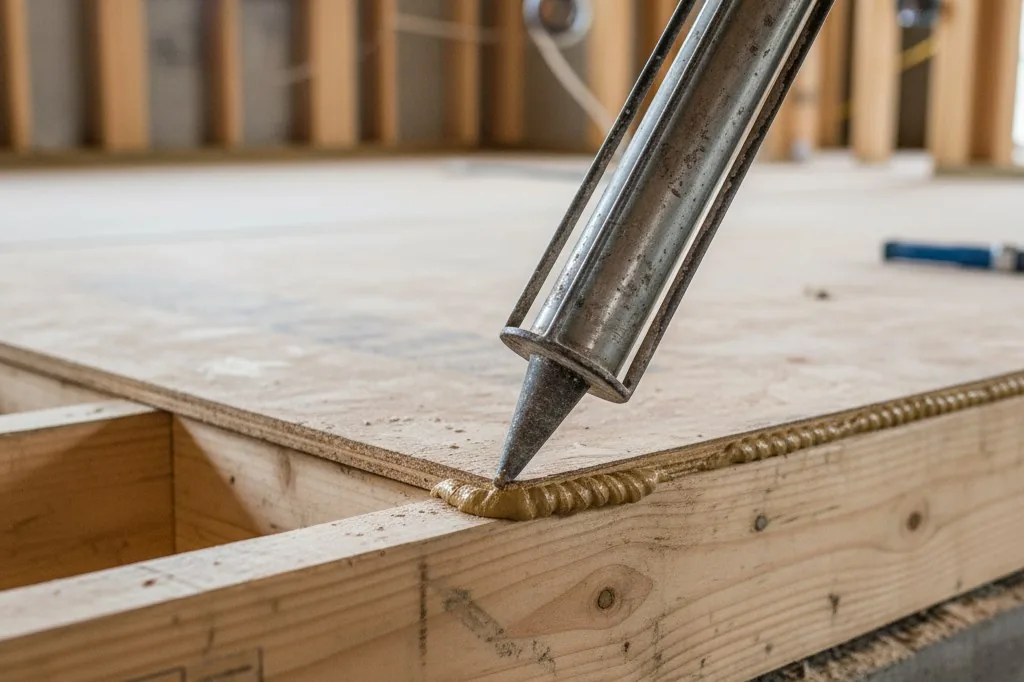
Construction adhesive in a caulking tube. That’s what the finish carpenter told me to use, and he was absolutely right.
Specifically, a heavy-duty polyurethane construction adhesive like Loctite PL Premium or Liquid Nails Heavy Duty. You squeeze a thick bead along the top of the joist where the subfloor is supposed to sit, right into that gap, then screw the floorboard back down through the finish floor and into the subfloor while the adhesive is still wet.
The adhesive fills the void completely, bonds the layers together, and cures rock-hard in about twenty-four hours. No compression, no movement, no creak. It’s not shimming the gap—it’s gluing the gap shut.
I used one $7 tube, applied it with a standard caulking gun I already had, and drove three 2½-inch wood screws in a line down the length of the problem area. I pre-drilled and countersunk the holes so the screw heads would sit below the surface of the floorboard. Then I clamped everything tight with the screws while the adhesive set overnight.
The next morning I filled the screw holes with Minwax stainable wood filler, let that dry for an hour, sanded it flush with 120-grit paper, and touched up the color with a stain marker that matched the rest of the floor. You’d never know I was in there.
That was eighteen months ago. I’ve walked over that spot probably a thousand times since. Dead silent every single time.
The one mistake to avoid? Over-tightening the screws before the adhesive has a chance to spread. You want firm, even contact between the subfloor and the joist, but not so much pressure that you squeeze all the adhesive out sideways and end up with a starved joint. Snug is good. Gorilla-tight is not.
When to stop and call someone: If multiple boards creak in a pattern—say, a whole line of them running parallel, or a section near a wall—you might be looking at a structural issue, not just a gap. Same if the floor feels spongy or noticeably uneven when you walk on it, or if you see cracks in the ceiling below. That’s not a tube-of-glue problem. That’s a sagging joist, undersized framing, or foundation settling, and you need a structural contractor or engineer to take a look before you do anything else.