My Shed Stayed Dry in Normal Rain for Three Years. Then One Storm Told Me What I'd Missed.
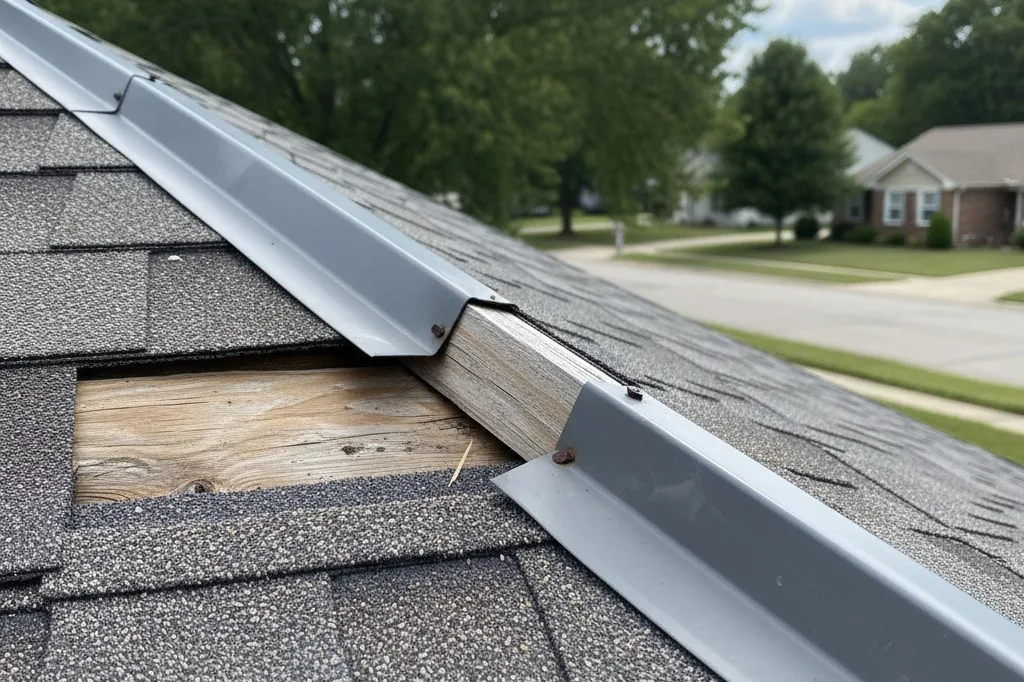
The Gap I Couldn’t See
The drip edge looked fine from the ground. It was doing its job along the eaves, channeling water into the gutters like it should, no overflow even in heavy rain.
But at the rake—the angled edge where the roof meets the gable end—there was a hairline gap between the metal and the wood trim beneath it. Maybe a sixteenth of an inch, maybe a little more in spots where the trim wasn’t perfectly straight.
Most of the time, that gap didn’t matter. Rain falls down, gravity does its thing, and the shingles and drip edge work together to keep water moving in the right direction. Even a hard rain from directly overhead just runs off.
But when wind pushed rain at a steep angle, hitting the rake almost horizontally, water could work its way under the drip edge and behind the trim. From there it followed the path of least resistance—not back out, but inward, running along the top plate of the wall frame and eventually finding its way through a nail hole or a seam in the sheathing.
I’d installed that drip edge three years ago, right after I built the shed. Nailed it every eight inches with galvanized roofing nails, overlapped the corners the way the instructions showed, made sure it extended past the fascia to throw water clear. What I’d never thought to do—and what wasn’t mentioned anywhere in the packaging directions or the roofing videos I’d watched—was seal that joint with caulk.
It’s not code, at least not here. The drip edge is supposed to work by shape and overlap alone, and most of the time it does. But “most of the time” isn’t the same as “every time,” and a wind-driven rain is exactly the condition where that gap becomes a problem.
I pulled up the weather history for that storm. Winds had gusted to thirty-four miles an hour from the west-northwest, which hit the rake edge dead-on. We’d had stronger winds before, but not with that much rain at the same time, and not from that direction.
So what actually fills that gap, and how much does a fix like this cost?