My Dryer Ran Three Times Per Load Until I Found the Real Problem
The Ten-Minute Fix
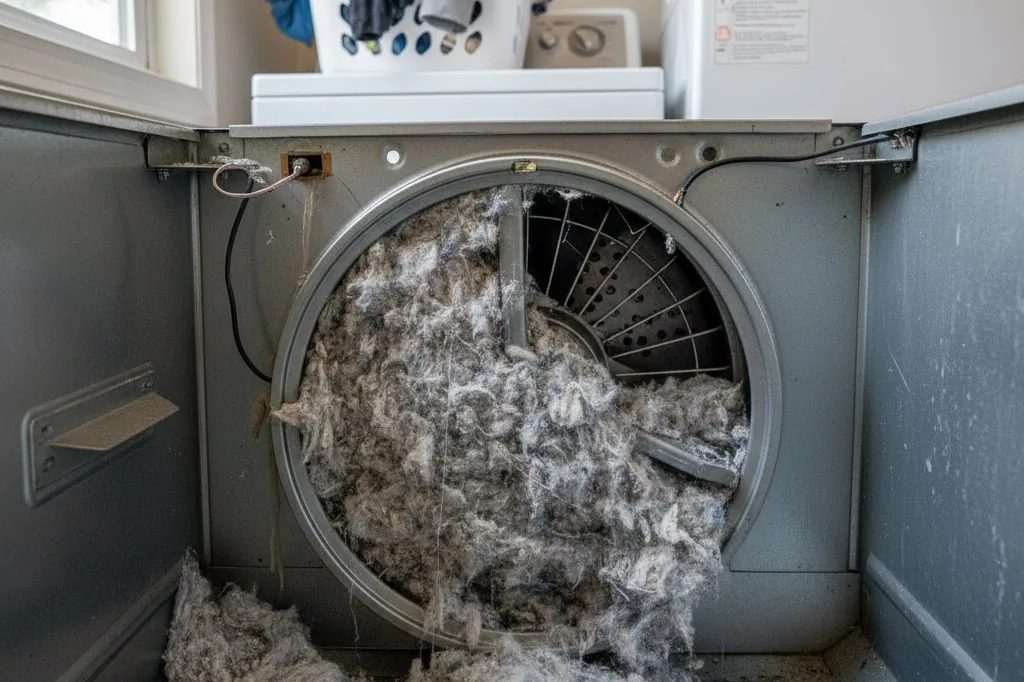
I unscrewed the lower front panel of my dryer—four screws along the bottom edge, took maybe two minutes with a Phillips head—and aimed a flashlight at the blower housing.
It looked like a felted wool sweater had grown inside the machine.
The blower housing is where air gets pulled through before it exits into your duct. It’s basically a metal chamber with a fan wheel inside, and lint sneaks past the trap and packs in there over months or years. In my case, it had been years. The buildup was dense, gray, and packed so tight it had restricted the fan blades. I could barely see the wheel itself under the matted layer.
That’s why my dryer was taking three cycles. It wasn’t a broken part. It was suffocation.
You’ll need a vacuum with a crevice tool, a long flexible brush—dryer vent brushes run about $10 at Home Depot or Lowe’s, and they’re basically a bottle brush on a two-foot handle—and a screwdriver. Pull the dryer out, unplug it from the wall, and disconnect the vent duct from the back. If it’s a gas dryer, turn off the gas supply valve before you do anything else.
Accessing the blower housing means removing a panel. On my dryer, a Whirlpool mid-range model, it was the lower front panel. On some machines it’s the rear panel, and on a few it’s accessed through the top or by pulling the drum forward. The layout varies enough that if you’re not confident about what you’re looking at once it’s open, this is a reasonable place to call someone. You’re near electrical connections, the heating element, and in some cases the gas line.
If you’re comfortable proceeding: vacuum out the blower housing first, pulling out as much of the compacted lint as the nozzle will grab. Then use the brush to loosen what’s caked onto the fan blades and the housing walls. Work slowly. You’ll be surprised how much comes out. I filled a grocery bag.
Clean the entire vent line while you’re at it—the duct that runs to the outside. Disconnect it, shake it out if it’s flex duct, or run the brush through if it’s rigid. If your vent run is longer than ten feet or has more than one elbow, consider spending $150 to $200 to have it professionally cleaned every couple of years. That’s cheaper than a service call when your dryer stops working, and way cheaper than a dryer fire.
The whole job took me maybe thirty minutes, and my dryer went back to one cycle per load. Towels came out fluffy and hot. Jeans dried in forty minutes. I haven’t had to run a second cycle since.
When to call a pro: If you smell gas, see scorch marks, find any wiring that looks damaged, or aren’t comfortable working inside the machine, don’t improvise. A dryer fire is not worth the DIY savings. If your vent run goes through walls or up to the roof and you can’t access it safely, hire someone with the right tools. And if you open the panel and what you see doesn’t match any diagram you can find for your model, close it back up and call a repair tech. Some things are worth paying for.