I Cleared My Gutters Twice in One Month – Then I Looked Up
The Real Fix
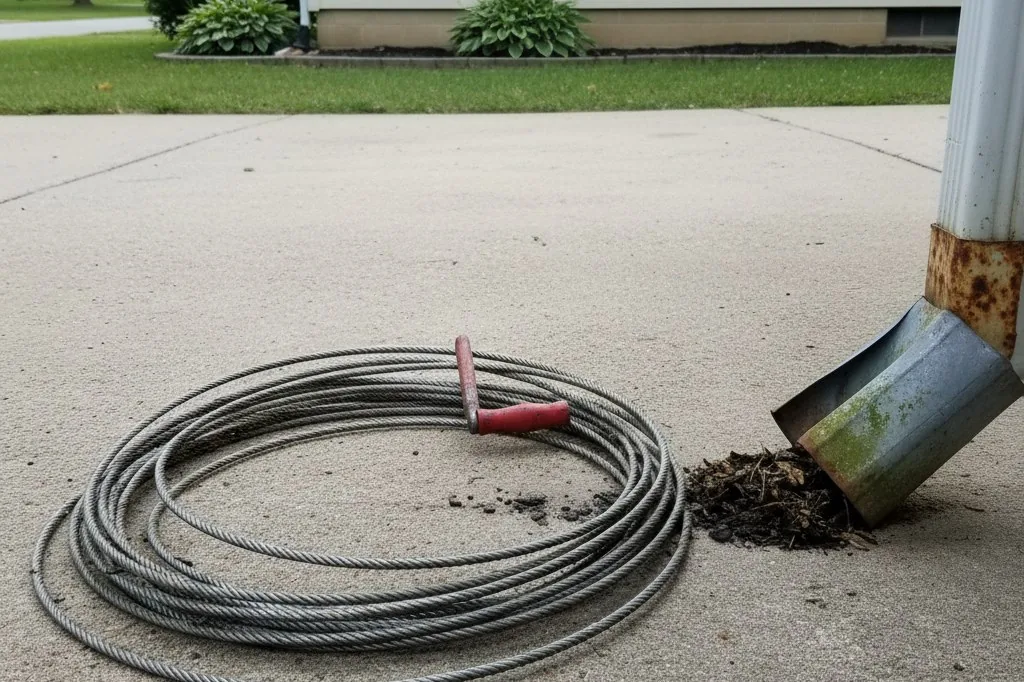
I bought a 25-foot plumber’s snake from Home Depot for about $18. The kind with a hand crank and a flexible coil that can navigate bends without tearing up aluminum or vinyl downspouts. It’s the same tool you’d use for a clogged sink drain, just longer.
Feed it in from the top opening where the gutter meets the downspout. Work it down slowly, cranking as you go, until you feel resistance. That’s your clog. You’ll know it when you hit it—the cable stops advancing smoothly and starts to push back.
Push and twist until you break through, cranking the handle in short, steady motions. You’re not trying to drill through concrete; you’re breaking up a mass of compressed organic matter so water can flow again. It took me about five minutes of cranking before I felt the cable punch through and drop freely down the rest of the tube.
Then pull the snake back up. You’ll drag up a surprising amount of compressed leaf matter, grit, and organic sludge. Have a bucket ready. The first time I did this, I pulled up what looked like a solid plug of black muck about eight inches long. It smelled like a wet basement.
After you clear the blockage, flush from the top with a garden hose for a few minutes to wash out what the snake loosened. You’ll know it’s clear when water flows freely out the bottom, fast and clean, without pooling at the top. I ran the hose for a solid two minutes and watched brown water turn to clear.
A pressure washer works too, if you have one. Aim the wand down from the top opening and let the pressure do the work—most electric models put out around 1,500 to 2,000 psi, which is enough to blast through all but the most stubborn clogs. Just be gentle near seams and joints. Too much force can separate them, especially on older installations where the sealant has dried out.
Each downspout took me about twenty minutes. Total cost: under $20 if you already have a hose. The fix held through the rest of fall, though I plan to do it again every spring before storm season.
If your downspouts are connected to underground drainage pipes, don’t use a pressure washer. The force can push clogs deeper into the system where you can’t reach them, and clearing buried drain lines usually means calling a pro with a powered auger. That’s a $150 to $300 job, depending on your area.