I Cleared My Gutters Twice in One Month – Then I Looked Up
Looking in the Wrong Place
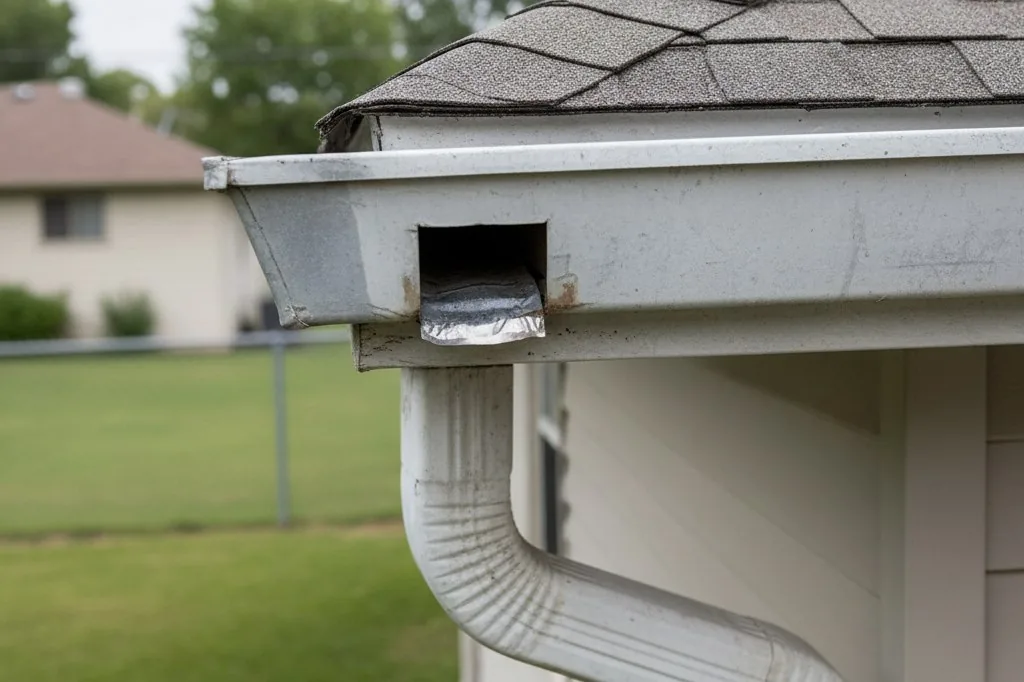
The downspout outlet sat right where it always had, a neat rectangular hole punched into the side of the gutter trough. Three inches wide, four inches tall, with crimped metal edges where the installer had cut the opening and attached the drop tube.
From where I stood on the ladder, it looked fine. Open. Doing its job.
But I stuck my finger in anyway, just to be sure—and hit something solid about two inches down.
Not leaves. Not a twig. Something dense and packed, like wet cement made of decomposed organic matter that had been sitting there since last fall. It had the texture of clay, but darker, and it didn’t budge when I tried to scrape it with my fingernail.
The gutter could be spotless from end to end, but if that opening—the only exit point for hundreds of gallons of runoff—gets blocked? The water has nowhere to go but over the side.
I’d been cleaning the highway while ignoring the off-ramp.
Worse, I couldn’t see how far down the blockage went. The downspout itself is a ten-foot vertical tube bolted to the side of my house with metal straps, and I had no idea if the clog was just at the top or if the entire thing was packed solid from top to bottom. I knocked on the outside of the tube with my knuckles—it sounded dull and heavy in some spots, hollow in others.
How do you even check that without taking the whole thing apart?
I didn’t want to unbolt the straps and pull the whole downspout off the wall. That’s an hour of work, and there’s always a chance you bend the aluminum when you’re wrestling it back into place. Plus, the straps on my house were screwed into old wood siding, and I wasn’t confident the screw holes would hold as well the second time.
I needed a way to see—or at least feel—what was happening inside that tube without disassembling it. And I needed to know whether this was a small clog I could clear in five minutes or a bigger problem that would eat up my Saturday.