The Kitchen Sink Smell That Kept Coming Back Every Three Weeks
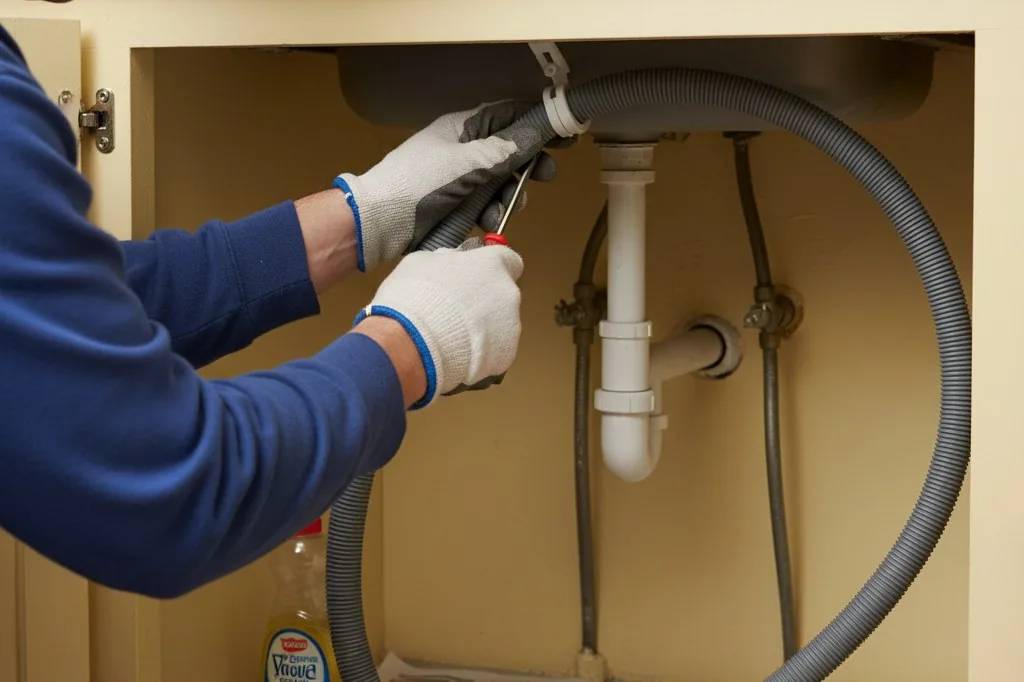

How I Fixed It
I replaced the dishwasher drain hose and installed it with a proper high loop. That’s it. No replumbing, no new dishwasher, no expensive service call.
The old hose had a low-loop section that sagged between the dishwasher and the sink drain connection, right in the middle of the cabinet. My plumber friend explained that water was pooling there after every cycle, never fully draining—just sitting there feeding bacteria and building up that sour biofilm smell I’d been chasing for months.
I bought a universal dishwasher drain hose at Home Depot for $12. It’s a six-foot corrugated tube, gray or black, with clamp fittings on both ends. Some come with the clamps included; mine didn’t, but I already had a pair of adjustable hose clamps in the garage. If you don’t, add another $3.
The replacement took about twenty minutes. First, I put a shallow baking pan under the connections to catch the water that was going to spill—there’s always some left in the line. Then I loosened the hose clamp at the dishwasher outlet (right side of the machine, low down, usually a ribbed plastic nipple about an inch wide) and pulled the old hose off. Same thing at the sink drain connection, which on mine was a barbed fitting on the tailpiece just below the basket strainer.
I pulled the old hose out and immediately smelled it. That was the source, no question. The inside walls were coated with a thin gray-brown slime that reeked.
Routing the new hose was the only part that required any thought. Instead of letting it droop across the back of the cabinet, I ran it upward first, securing it to the underside of the countertop with a zip tie looped through a small screw eye. The high point of the loop sat about two inches below the countertop—higher than both the dishwasher outlet and the drain connection. Then I let it drop down into the sink drain.
That high loop is the whole fix. Water can’t sit in the hose anymore because gravity pulls it all the way through and into the drain. No standing water, no bacterial growth, no smell.
Total cost: $12 for the hose, $3 for clamps if you need them, and maybe $1 for a zip tie and screw eye if you don’t have those lying around. I already had a bucket, a towel, and an adjustable wrench.
One warning, though. If you see water actively leaking around the sink drain connection itself—not just residual water inside the hose—or if the drain pipe under the sink looks corroded, cracked, or loose where it meets the wall, stop. That’s a plumber’s job. A bad seal or damaged drainpipe means water damage you can’t see yet, possibly inside the wall or under the subfloor, and DIY won’t cut it. Same goes if you’re not confident identifying which hose is which under there; some cabinets have multiple lines, and you don’t want to disconnect the wrong thing.
But if it’s just the dishwasher drain hose and the fittings are solid, this is a straightforward fix. I haven’t had the smell come back once in four months.