Three Heating Contractors Missed the Draft — A Candle Found It in Four Minutes
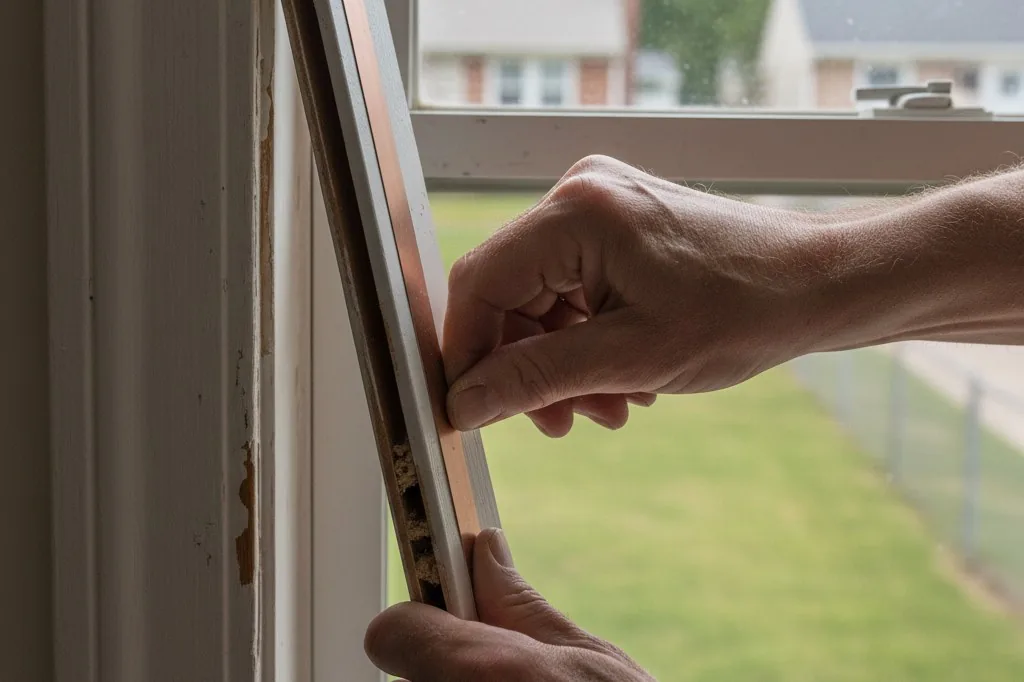

Matching the material to the gap
Moving joints — V-strip weatherstripping, about $4 for seventeen feet. Use this for anything that has to open and close: the sash meeting rail on a double-hung window, the edge of a casement, the bottom of a door if it does not already have a sweep. Press it into the channel with the open side of the V facing the direction of the draft. Cut it half an inch long and compress it into place rather than stretching it to fit — stretched vinyl relaxes over one winter and the gap comes straight back, which is why this repair has a reputation for not lasting. The compression is what makes the seal. I have V-strip that has been in place for four years now and it still springs back when you push on it.
Static joints under a quarter inch — paintable acrylic-latex caulk, about $6 per tube. This is for the frame-to-wall joint, sill gaps, and any place where the baseboard has pulled away from the wall. Smooth it with a wet fingertip within about a minute, before it skins over. If you wait too long it goes rubbery and drags instead of smoothing, and you will spend twenty minutes trying to fix something that would have taken ten seconds if you had done it immediately.
Use acrylic-latex, not silicone, anywhere you intend to paint. Silicone rejects paint permanently — it beads up on the surface and will not take a coat however carefully you sand and prime. That single choice is the difference between an invisible repair and a shiny line across your trim forever. I made this mistake once, on a baseboard gap in a rental, and spent an hour trying to get paint to stick before I gave up and scraped the whole bead out.
Buy caulk at any hardware store. DAP Alex Plus is fine and costs about six dollars. You do not need premium.
Gaps over a quarter inch — backer rod or low-expansion foam, then caulk over. Use low-expansion foam specifically, not the standard gap-filling kind. Standard foam can triple in volume as it cures and it will bow a doorframe inward or crack your drywall. Low-expansion foam costs about $8 for a can at Home Depot or Lowe’s and says “low-expansion” or “window and door” on the label. Let it cure for an hour, trim it flush with a utility knife, then caulk over it so it does not show.
My repair came to eleven dollars: one tube of caulk, one pack of V-strip, and I already had the putty knife. It took about an hour, most of that time spent easing the door trim off without splitting it. I worked a stiff putty knife behind the casing, tapped it gently with a hammer to break the paint seal, then pried slowly from several points along the length so the nails would pull evenly. The trim came off clean and went back on with the same nail holes.
February came in at a hundred and sixty dollars. March was a hundred and ten.
When to stop and call someone
If the frame is soft when you press a screwdriver into it, if the glass moves in the sash and the putty is crumbling, or if you can see daylight through a crack in the frame itself, none of this will hold. Rot does not take caulk. Sealing over it traps moisture against wood that is already failing and makes it worse. That is a carpenter’s job, not a caulk job, and it will cost somewhere between three hundred and fifteen hundred dollars depending on whether the rot is confined to the sill or has moved up into the jamb.
The part I still find hard to accept is that three professionals with thermal cameras and infrared thermometers missed it, and a retired carpenter with a candle found it in four minutes — because he was the only one who asked what had changed.